May 22, 2026 · 5 min read · By Amay Verma
India's Garbage Problem Has a Sorting Crisis And Cameras Might Fix It
Every single day, Mumbai generates 9,000 tonnes of municipal solid waste. Delhi generates 11,352 tonnes. And the vast majority of it ends up in the same place, a giant, unsorted pile at an overflowing landfill.
India produces around 62 million tonnes of solid waste every year. More than 90% of it is dumped into unmanaged landfills, releasing methane into the atmosphere and leaching toxins into groundwater. The scale is staggering. But here is the truth, the root cause is not just a lack of trucks or landfill space. It is that the waste is never properly sorted in the first place.
Waste practices
- Open dumping
- WtE incineration
- Informal e-waste
- Biomedical mishandling
- Rural open burning
Environmental impacts
- GHG emissions
- Groundwater poisoning
- Soil contamination
- Air quality decline
- Heavy metal leaching
Health outcomes
- Respiratory illness
- Waterborne disease
- Neuro-toxicity
- Skin disease
- Double exposure burden
Reinforces reliance on low-cost disposal
The Segregation Problem Is Hiding in Plain Sight
When wet kitchen scraps, dry plastics, and hazardous e-waste all end up in the same bin, the damage cascades. Waste-to-Energy (WtE) plants, often pitched as the modern solution, underperform and can worsen climate outcomes when fed India's high-moisture, unsegregated waste. A Life Cycle Assessment of Delhi's MSW system found that simply prioritizing at-source segregation and composting over landfilling and incineration reduces negative environmental impacts across all measured indicators by an average of 23%.
The math is simple: sort better, pollute less.
But who is doing the sorting right now? Largely, the informal sector, waste pickers who spend their days sifting through hazardous trash with no protective gear, absorbing the health costs that regulators have failed to address. Behavioral research confirms that most residents do not segregate at home, not because bins are not available, but because psychosocial factors, like whether people feel their actions actually make a difference, are stronger predictors of behavior than infrastructure alone.
You cannot engineer your way out of a behavior problem. At least, not without the right technology.
Where Computer Vision Comes In
This is where things get genuinely exciting. Computer vision systems, powered by advanced artificial intelligence and deep learning algorithms, offer a direct solution to the segregation bottleneck that every other intervention struggles to overcome. By deploying high-resolution cameras at conveyor belts or centralized collection points, waste can be identified, tracked, and classified in real time. A robustly trained vision model can easily distinguish between organic waste, dry recyclables, e-waste, and hazardous biomedical materials with a level of precision and speed that far surpasses human capabilities.
When this visual data is fed into an automated sorting arm or pneumatic ejection system, facilities can instantly separate mixed streams. This replaces the most tedious, unsanitary, and hazardous step in the entire waste management chain. Furthermore, these systems continuously learn from new data, meaning their accuracy improves over time even as packaging materials change. By integrating computer vision, municipalities can drastically reduce the contamination rates of recyclable materials, ensuring that valuable resources do not end up in landfills.
The economic case is already being made with related technology. Mathematical optimization models applied to India's e-waste reverse logistics have been shown to cut operational costs by 26.9% and increase recovered resource value by 40%. Computer vision sorting would amplify these gains by dramatically improving the quality and purity of separated material streams, as higher purity recyclables command significantly better market prices.
There is also a $15 billion circular economy opportunity tied up in recovering value from waste streams, particularly e-waste and organic material. Most of that value is currently destroyed because waste arrives mixed and contaminated. Better segregation, whether by humans or machines, is the unlock.
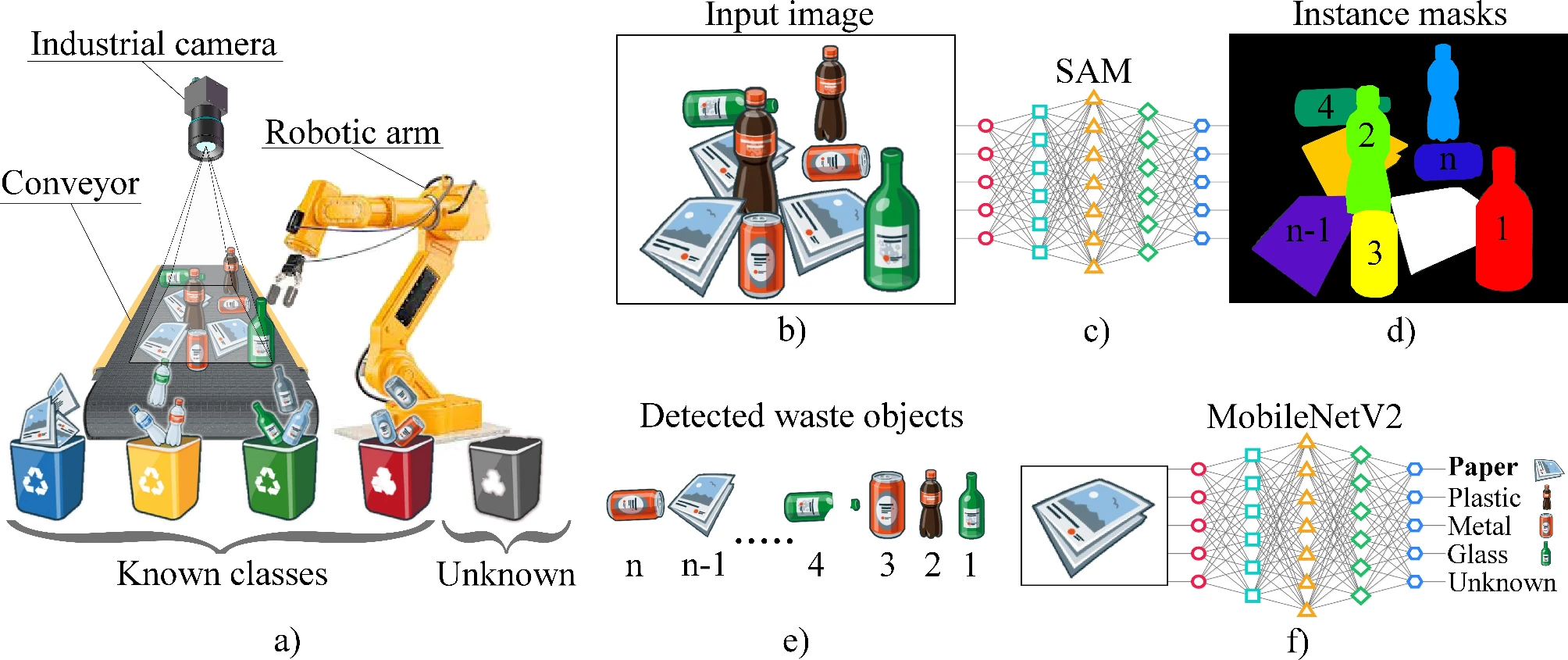
Smart city IoT pilots are already showing that technology-led approaches to waste logistics work, but researchers caution they need institutional backing to scale. Computer vision fits neatly into this framework: deploy at transfer stations, large apartment complexes, or industrial collection points where volume is high enough to justify the investment.
The Caveat
Computer vision is not a silver bullet. The research is clear on this: isolated solutions fail because the challenges are interconnected. A camera that sorts waste perfectly at a facility cannot fix the fact that waste arrives pre-mixed from households. Upstream behavior change and downstream technology need to move together.
But as a piece of a larger system, one that also redesigns behavioral incentives, funds Urban Local Bodies properly, and integrates informal waste workers rather than displacing them, computer vision sorting could be the most scalable, cost-effective intervention available today.
The piles are not going anywhere. The cameras might be the fastest way to start making sense of them.
References
- 1Jardosh, N., & Kathuria, V. (2025). Social cost benefit analysis of solid waste management options with application to Mumbai, India. Waste Management and Research, 43(1), 39–49.
- 2Mazzoli, E., et al. (2024). Greening the city: A holistic assessment of waste management alternatives in India. Science of the Total Environment, 955.
- 3Ali, W. (2025). Optimizing the e-waste management in India: A sustainable mathematical modeling approach to circular economy. Quality and Quantity, 59(5), 4647–4678.
- 4Tiwari, D., et al. (2023). Systemic economic viability of informal sectors: E-waste management. Nature Environment and Pollution Technology, 22(3), 1431–1445.
- 5Pratap, V., et al. (2020). Role of psychosocial factors in effective design of solid waste management programmes: Evidence from India. Environment and Urbanization ASIA, 11(2), 266–280.
- 6Tayeng, T., et al. (2024). Smart city initiatives and urban governance in India. Journal of Applied Bioanalysis, 10(2), 155–163.
- 7Kumar, V., & Shukla, O. J. (2025). A sustainable framework to address e-waste management solutions: An Indian perspective. Journal of Material Cycles and Waste Management, 27(3), 1637–1662.